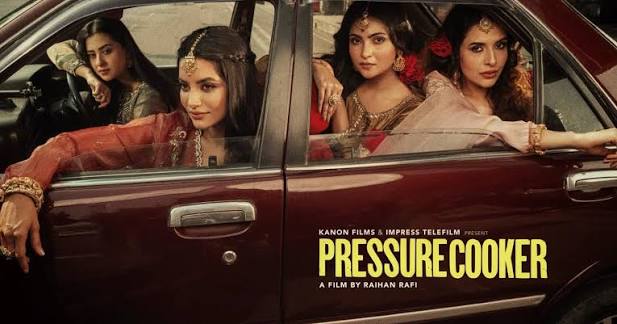
[Pressure Cooker (Bengali: প্রেশার কুকার) is a 2026 Bangladeshi Bengali language hyperlink drama-thriller directed by Raihan Rafi.The film features an ensemble cast led by Shobnom Bubly, Nazifa Tushi, Maria Hossain Shanto, and Snigdha Chowdhury]
…
In “Pressure Cooker,” Islam is simply the national culture.
There is a register in Raihan Rafi’s Pressure Cooker that no Bangladeshi will find strange and every ideologue should find unbearable. The criminals reach for the vocabulary of Islam in the same breath with which they reach for the blade.
The film does not offer this as irony, nor as an exposé of religion unmasked. It offers it as unremarkable, and in that unremarkableness lies its quiet argument.
Rafi has made a film in which Islam is everywhere. Precisely because it is everywhere, it belongs to no one.
This cuts against the grammar of our public life. That grammar insists the nation be sorted into two tribes, the religious and the secular, and that everything of consequence happens at the border between them.
Talal Asad spent a career dismantling this. The secular, he argued, is not the empty space left once religion withdraws; it is a modern arrangement that produces “religion” as its own mirror-image, deciding in advance what will count as faith so that faith may be managed, contained, and, when convenient, feared.
The two categories are not ancient antagonists but modern twins, born together, each unintelligible without the other. Pressure Cooker performs this insight without ever naming it, because it has stopped believing the two sides of our national quarrel are as separate as they advertise.
Consider Reshma and her burqa. It makes her an upstanding woman in the countryside and to her own family, and it carries her, unquestioned, into the sex work she performs elsewhere.
To read this as hypocrisy, the pious costume hiding the impious body, is to miss what the film is showing. The burqa is not a confession she betrays; it is infrastructure, a technology of passage between social worlds that would otherwise refuse her entry.
She is not a symbol of anything. She is a woman doing the arithmetic the city handed her, and the sum does not balance.
The madrassah, meanwhile, does what neither the secularist nor the Islamist can comfortably narrate. It takes in Reshma’s child, feeds and shelters him when she cannot meet his costs, and asks her for neither ideology nor rent.
Here the institution our commentators cast as a nursery for militants, and its defenders cast as a monument to piety, appears as something more ordinary and more true. It is simply where the poor leave their children.
The film neither indicts it nor sanctifies it, and that refusal is itself the argument.
The objection that leaps up in the secularist’s mind is obvious. Surely, one might say, the Islam-invoking villains prove the old point that religion is merely a costume for the wicked.
But Rafi closes that exit. Adnan Sheikh invokes Islam from the stage and beats his wife at home, and his hypocrisy is real, and the film grants it.
Yet the film will not let his rottenness settle the account. His wife, who carries every progressive value, keeps a lover and sanctions murder.
If piety does not cleanse the pious, secular conviction does not cleanse the progressive. Nobody in this Dhaka leaves with clean hands.
The devout do not own Islam, and the corrupt do not disprove it.
What the film restores to Islam, then, is a privilege usually reserved for the dominant: the privilege of being banal. In any social order, the unmarked category earns the right to signify nothing in particular, to be simply the air, while the marked category must stand for something at every moment, perpetually on trial.
In our public life Islam is endlessly marked, dragged into the witness box to answer for the nation’s every anxiety. In Rafi’s Dhaka it is finally allowed to be the ground rather than the exhibit.
It is the grammar everyone speaks, devout or venal, rather than the ideology anyone must be recruited into or protected from.
This is the one thing our two vanguards cannot permit, and it explains their symmetrical panic. The secularist needs Islam marked as backwardness, because our official secularism survives by filing faith under the not-yet-modern.
The Islamist needs Islam marked as sacred property, scarce and guarded. A faith that has quietly become the national culture cannot be owned, defended, or made the basis of an oath of allegiance.
Rafi leaves it unmarked, abundant, and therefore unavailable to either project. You cannot conscript the ordinary, and you cannot hoard the air.
None of this makes the film a comfortable one, and it is not meant to. Its women are trapped, its men are worse, and its mercy is only the mercy of the honest mirror, the refusal to divide a city into the saved and the damned.
That is why it sits so easily with audiences and so uneasily with the commentariat. The public already lives this way; only the ideologue is scandalised to see ordinary life projected on a screen.
Our long quarrel was never between a religious nation and a secular one. It was between two small minorities, each certain that it owned the meaning of a faith the majority simply lives.
Rafi has handed that faith back to the people who carry it. In Pressure Cooker, Islam belongs to everyone, which is to say to no one, and that is the most honest thing our cinema has said in years.

মোহাম্মদ ইশরাক
Latest posts by মোহাম্মদ ইশরাক (see all)
- Banalizing Islam - জুলাই 4, 2026
- এসেনশিয়ালিস্ট রাষ্ট্রকল্পে খেলাফত ও ইসলামপন্থা বনাম ঐতিহাসিক কন্টিঞ্জেন্সি - সেপ্টেম্বর 22, 2025